

When planning an extension to an existing building, one common question that gets asked is whether you can use an existing boundary wall as the external wall of the new extension.
Obviously, there would be benefits to doing this. Such as the cost saving from not having to build another wall, as well as being able to have a larger internal area.
The short answer is: Sometimes!
Ultimately, it depends on who owns the wall. This is generally determined by where it sits in relation to the boundary, and what kind of wall it is. We then move onto what rights exist under the Party Wall etc. Act 1996.
This guide explains the most common boundary scenarios and what they mean in practice.
What Is a Boundary Wall vs a Party Wall?
Before looking at specific scenarios, it helps to understand the terminology. The rules around using a wall to your advantage depend on where it is located, and therefore who owns it.
Boundary wall
A wall that marks the boundary between two properties. It will sit entirely on one owner’s land.
Party wall
A wall shared by two adjoining properties, typically forming part of both buildings. These are common in terraced and semi-detached houses. A garden wall can also be a party wall, but in this instance, it is known as a party fence wall.
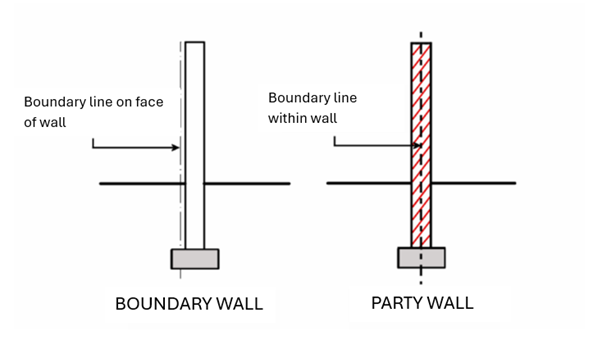
Scenario 1: Enclosing Against A Party Wall
Yes, you can build.
Where a party wall sits within the boundary line, both adjoining owners have rights over the wall. This gives each owner statutory rights to carry out certain works to the wall, provided the correct notices are served under the Act. Formal consent is not required, however a Party Wall Award may still be necessary to regulate the timing and manner in which the works are carried out.
Key points to note
- Approval from neighbour not required
- Notices still need to be served
- May need to pay enclosure costs if this wall was subsequently built by the neighbour at their own cost
Scenario 2: Enclosing against a Boundary Wall
You can only build if consent is given by your neighbour.
Where a boundary wall is positioned wholly on the neighbour’s land, with the boundary line running along the face of the wall, there is no automatic right for you to use this wall. The wall may only be used with the adjoining owner’s written consent. Once consent is given and the wall is enclosed upon, it becomes a party wall and both owners will thereafter have rights over it.
Key points to note
- Neighbour can refuse consent to use the wall
- There will be a onetime payment for use of the wall
- It may be necessary to build whole new external wall entirely on your own property
In summary, whether you can use a boundary wall as part of your extension depends entirely on the wall’s ownership and position, identifying this early is essential to avoid disputes, delays, and redesigns.
George Ramsay CEng MICE MFPWS
Director – Geared Consulting Partnerships
Chartered Structural & Civil Engineers l Party Wall Surveyors